
Neck pain, numbness in the hands, difficulty walking and loss of coordination are symptoms that should not always be attributed to ageing or everyday physical strain. In some cases, these problems may indicate a condition called cervical myelopathy, which develops when the spinal cord in the neck becomes compressed.
Recognising the early warning signs and obtaining an appropriate medical evaluation can help identify the condition and determine the most suitable treatment.
Quick Answer
Cervical myelopathy is a progressive neurological condition caused by compression of the spinal cord in the neck. Unlike simple neck strain or a pinched nerve root, it disrupts signals traveling between the brain and the body, making early recognition essential to prevent permanent nerve damage.
What Causes Cervical Myelopathy?
Cervical myelopathy commonly develops when structural changes in the neck reduce the space available for the spinal cord.
Some of the common causes include:
1. Cervical Disc Degeneration
The discs between the cervical vertebrae act as cushions and allow the neck to move. With ageing, these discs may lose hydration and flexibility, reducing their height and contributing to spinal canal narrowing.
2. Herniated or Bulging Disc
A cervical disc may bulge or herniate into the spinal canal and press against the spinal cord. Depending on its location and severity, this can cause neurological symptoms.
3. Bone Spurs
Age-related changes in the cervical vertebrae can result in the formation of bone spurs, also called osteophytes. These bony growths may narrow the spinal canal and contribute to spinal cord compression.
4. Cervical Spinal Stenosis
Cervical spinal stenosis refers to narrowing of the spinal canal in the neck. When the available space becomes insufficient, the spinal cord may become compressed.
5. Thickening of Spinal Ligaments
The ligaments supporting the cervical spine may thicken or become less flexible over time. In some individuals, this can further reduce the space around the spinal cord.
6. Other Structural Conditions
Less commonly, cervical myelopathy may result from spinal injuries, congenital narrowing of the spinal canal, tumours or other conditions affecting the cervical spine.
Early Symptoms of Cervical Myelopathy You Should Not Ignore
Cervical myelopathy can develop gradually, and early symptoms may be subtle. Many people initially notice changes in hand function, sensation or walking rather than severe neck pain.
Recognising these symptoms is important because untreated spinal cord compression may lead to worsening neurological difficulties.
1. Numbness and Tingling in the Hands
One of the early symptoms may be numbness or tingling in the fingers and hands. Some individuals experience unusual sensations in their arms or legs.
These symptoms can interfere with routine activities such as holding objects, writing or using a mobile phone.
2. Difficulty With Hand Coordination
Compression of the spinal cord can affect fine motor control.
Patients may experience difficulty with:
- Buttoning shirts or fastening clothes.
- Holding small objects.
- Writing or typing.
- Handling coins or utensils.
- Performing tasks that require precise finger movements.
This loss of hand dexterity is an important warning sign.
3. Difficulty Walking and Maintaining Balance
Cervical myelopathy may affect the nerves responsible for coordinating movements of the legs.
Some patients experience:
- Unsteadiness while walking.
- Difficulty climbing or descending stairs.
- A feeling of heaviness in the legs.
- Frequent stumbling or falls.
- Difficulty maintaining balance.
These symptoms may gradually interfere with independent mobility.
4. Weakness in the Arms or Legs
Spinal cord compression can affect signals responsible for muscle movement. This may cause weakness in the hands, arms or legs.
Some people notice reduced grip strength or difficulty lifting objects, while others experience weakness or stiffness in their lower limbs.
5. Neck Pain and Stiffness
Neck pain and restricted neck movement may occur alongside cervical myelopathy. However, not every patient experiences significant neck pain.
The absence of severe neck discomfort does not rule out spinal cord compression.
6. Changes in Reflexes and Muscle Control
A neurological examination may reveal unusually brisk reflexes, increased muscle tone or abnormal reflex responses.
These findings can help a specialist identify possible spinal cord involvement.
7. Bladder or Bowel Control Problems
In more advanced cases, cervical spinal cord dysfunction may affect bladder or bowel control.
New urinary retention, incontinence or loss of bowel control, particularly alongside worsening weakness or walking difficulties, requires urgent medical assessment.
How Is Cervical Myelopathy Diagnosed?
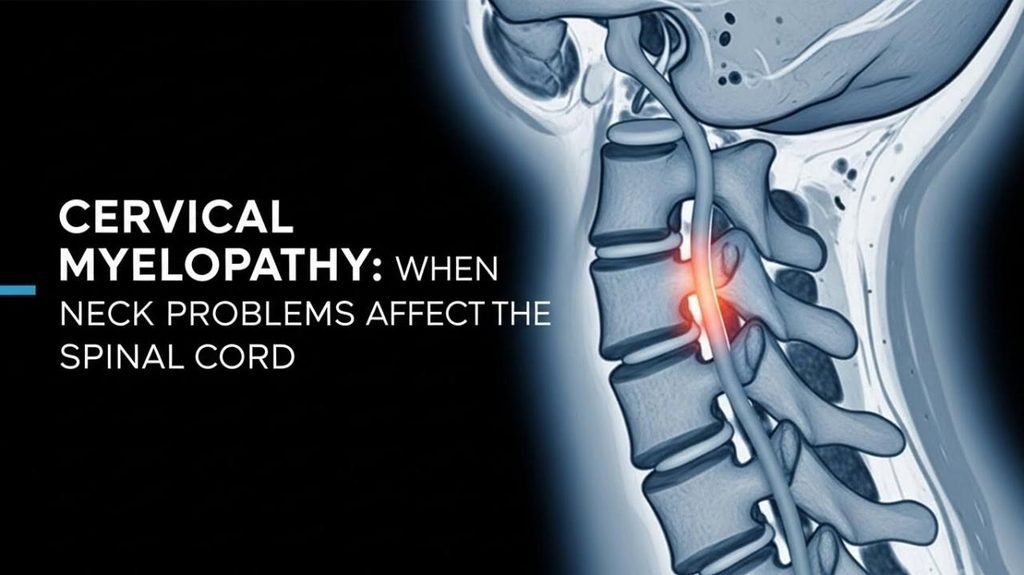
Accurate diagnosis involves correlating a patient’s symptoms, neurological examination and imaging findings. An MRI showing spinal cord compression is important, but imaging must always be interpreted alongside the clinical examination.
1. Medical History and Symptom Evaluation
The specialist will discuss the patient’s symptoms, when they started, how they have progressed and whether they affect daily activities.
Information about previous neck injuries, existing medical conditions and changes in walking or hand coordination may also be relevant.
2. Neurological Examination
A detailed neurological examination helps assess how well the spinal cord and associated nerves are functioning.
The examination may include:
- Testing muscle strength in the arms and legs.
- Checking sensation in different body regions.
- Assessing deep tendon reflexes.
- Evaluating hand coordination and dexterity.
- Observing walking patterns and balance.
- Checking for signs of abnormal muscle tone.
3. MRI of the Cervical Spine
Magnetic Resonance Imaging (MRI) is generally the preferred imaging investigation for suspected cervical myelopathy.
It provides detailed images of the spinal cord, intervertebral discs, ligaments and surrounding soft tissues.
An MRI can help identify:
- Spinal cord compression.
- Herniated or bulging cervical discs.
- Narrowing of the spinal canal.
- Degenerative changes.
- Abnormal signal within the spinal cord.
4. CT Scan and X-rays
X-rays help assess cervical spine alignment, bone structure and degenerative changes.
A CT scan provides more detailed information about the vertebrae and bone spurs. CT myelography may be considered in selected patients when MRI is unsuitable or additional anatomical information is needed.
5. Additional Neurological Tests
In selected cases, nerve conduction studies or electromyography (EMG) may help investigate other conditions that can produce similar symptoms.
These tests are not substitutes for MRI when spinal cord compression is suspected.
What Are the Treatment Options for Cervical Myelopathy?
The treatment of cervical myelopathy depends on the severity of spinal cord compression, neurological symptoms, examination findings, imaging results and the patient’s overall health.
The main objective is to prevent further neurological deterioration and preserve or improve functional ability.
1. Monitoring and Conservative Management
For carefully selected patients with mild symptoms, a specialist may recommend close clinical monitoring and a supervised rehabilitation programme.
This may include:
- Regular neurological assessments.
- Monitoring changes in walking and hand coordination.
- Appropriate pain management.
- Supervised physical therapy when suitable.
- Education about symptoms that require reassessment.
It is important to understand that conservative treatment may help manage associated discomfort and functional limitations, but it does not reliably remove mechanical pressure from the spinal cord.
Patients with neurological deterioration need prompt reassessment.
2. Cervical Decompression Surgery
When spinal cord compression is significant, particularly in moderate or severe cervical myelopathy, surgery may be recommended.
Cervical decompression surgery aims to create sufficient space around the spinal cord by removing or addressing the structures causing compression.
Depending on the patient’s anatomy and the location of compression, the surgeon may recommend an anterior or posterior surgical approach.
3. Anterior Cervical Discectomy and Fusion (ACDF)
ACDF is a commonly performed procedure for selected patients with cervical disc-related spinal cord compression.
During the procedure:
- The surgeon approaches the cervical spine from the front of the neck.
- The affected disc is removed.
- Pressure on the spinal cord and nerve structures is relieved.
- A spacer or bone graft may be placed.
- Fusion may be performed to stabilise the treated spinal segment.
The procedure is selected according to the patient’s spinal anatomy and clinical condition.
4. Cervical Laminectomy
A cervical laminectomy involves removing part or all of the lamina, which forms the back portion of a vertebra.
The purpose is to increase the available space within the spinal canal and relieve pressure on the spinal cord.
In selected patients, additional stabilisation with spinal fusion may be required.
5. Laminoplasty
Cervical laminoplasty is a surgical technique that expands the spinal canal while preserving more of the posterior spinal structures than a laminectomy with fusion.
It may be considered in selected patients with multilevel cervical spinal stenosis.
The suitability of this procedure depends on cervical alignment, the pattern of compression and other individual factors.
Is Cervical Myelopathy Surgery Always Necessary?
No. Not every person with cervical spinal canal narrowing requires surgery.
The decision depends on whether the patient has clinical evidence of spinal cord dysfunction, the severity of symptoms and the risk of further neurological deterioration.
Patients with moderate or severe degenerative cervical myelopathy are generally recommended to undergo surgical evaluation and decompression when appropriate.
For selected patients with mild disease, a specialist may discuss surgery or a supervised rehabilitation approach with close follow up.
However, if neurological symptoms worsen or conservative management does not improve the condition, surgery may become necessary.
Early specialist assessment is important because prolonged spinal cord compression can reduce the potential for neurological recovery.
What Is the Recovery Process After Cervical Myelopathy Surgery?

Recovery varies according to the patient’s age, general health, severity of spinal cord compression, duration of symptoms and type of surgical procedure.
Following surgery, the medical team monitors neurological function, pain, mobility and wound healing.
The recovery process may involve:
1. Early Mobilisation: Patients may be encouraged to begin walking and performing suitable activities under medical supervision.
2. Pain Management: Appropriate medication and postoperative care help manage discomfort.
3. Physiotherapy: A personalised rehabilitation programme may help improve mobility, strength and balance.
4. Activity Modification: Heavy lifting and strenuous activities may need to be restricted during the initial recovery period.
5. Follow up Assessments: Regular clinical reviews help monitor neurological function and surgical recovery. Imaging may be recommended when clinically indicated.
Some patients experience improvement in numbness, weakness and walking ability after decompression. However, recovery is not always complete, particularly when spinal cord damage has been present for a long time.
The primary objective of surgery is often to prevent further deterioration, although functional improvement may also occur.
When Should You Consult a Neurosurgeon?
You should seek specialist evaluation if you experience persistent or progressive symptoms such as:
- Numbness or tingling in the hands or arms.
- Increasing difficulty holding objects.
- Loss of hand coordination.
- Unsteadiness while walking.
- Weakness in the arms or legs.
- Persistent neck discomfort accompanied by neurological symptoms.
- Repeated falls or changes in mobility.
Sudden or rapidly worsening weakness, inability to walk or new bladder or bowel dysfunction requires urgent medical assessment.
Early diagnosis can help determine whether observation, rehabilitation or surgical treatment is appropriate.
Conclusion
Cervical myelopathy is a potentially progressive spinal cord condition that can affect hand coordination, muscle strength, sensation and walking ability. Although its early symptoms may appear mild, they should not be ignored, particularly when they are gradually worsening.
A combination of neurological examination and cervical spine MRI helps establish the diagnosis and guide treatment decisions. Depending on the severity, management may involve close monitoring, rehabilitation or surgical decompression.
If you are experiencing persistent neck related neurological symptoms, consulting an experienced neurosurgeon or spine specialist can help identify the underlying problem and determine an appropriate treatment plan.
Dr. Manish Rawat, an experienced neurosurgeon in Gurgaon, provides evaluation and treatment for complex brain and spine conditions, including degenerative spinal disorders and minimally invasive spine procedures.
Frequently Asked Questions
1. What are the first warning signs of cervical myelopathy?
Early warning signs may include numbness or tingling in the hands, reduced grip strength, difficulty buttoning clothes, poor hand coordination and unsteadiness while walking.
2. Is cervical myelopathy a serious condition?
Yes. Cervical myelopathy can be serious because spinal cord compression may lead to progressive neurological problems. Early evaluation is important to prevent further deterioration.
3. Can cervical myelopathy be treated without surgery?
Some patients with mild symptoms may be managed with close monitoring and supervised rehabilitation. However, conservative treatment does not reliably relieve mechanical spinal cord compression. Moderate, severe or worsening disease generally requires surgical evaluation.
4. Is an MRI necessary to diagnose cervical myelopathy?
MRI is generally the preferred imaging test because it shows the spinal cord, discs and surrounding soft tissues. Diagnosis also requires correlation with symptoms and neurological examination findings.
5. Can cervical myelopathy cause difficulty walking?
Yes. Compression of the cervical spinal cord can affect coordination and movement of the legs, resulting in unsteadiness, difficulty walking and an increased risk of falls.
About the Author
Dr. Manish Rawat – Senior Neurosurgeon in Gurgaon
Dr. Manish Rawat holds MBBS, MS (General Surgery) and MCh (Neurosurgery) qualifications and has over 25 years of medical experience. His areas of expertise include minimally invasive brain and spine surgery, endoscopic neurosurgery, complex spinal procedures and neurovascular interventions.
He focuses on accurate diagnosis, evidence based treatment planning and individualised patient care.
Website: https://drmanishrawat.co.in/
Consultation: 078957 77715
Specialisation: Neurosurgery, Brain Surgery and Spine Surgery

Doctor Manish Rawat, the best neurosurgeon in Gurugram, is a highly accomplished Senior Neurosurgeon with over 25 years of medical experience, including 18 years dedicated to neurosurgery.