
Quick Answer
Neither surgery is universally better the right choice depends on your specific spine anatomy, bone quality, and stability needs. Both Cervical Disc Replacement (CDR) and Anterior Cervical Discectomy and Fusion (ACDF) relieve pinched nerves or spinal cord compression through the front of the neck with high success rates, but they reconstruct the disc space differently.
Introduction
Persistent neck pain, pain radiating into the shoulder or arm, numbness, tingling and muscle weakness can sometimes be caused by a damaged or herniated cervical disc. When a disc in the neck presses on a spinal nerve or the spinal cord, it can lead to conditions such as cervical radiculopathy or cervical myelopathy .
Many patients improve with non surgical treatment, including medication, physiotherapy and activity modification. However, surgery may be considered when symptoms remain severe despite appropriate treatment, or when there is progressive neurological weakness or spinal cord compression.
Two surgical options commonly discussed are Cervical Disc Replacement (CDR) and Anterior Cervical Discectomy and Fusion (ACDF).
Both procedures remove the damaged disc and relieve pressure on nearby nerves or the spinal cord. The main difference is what happens after the disc is removed: cervical disc replacement uses an artificial disc to preserve movement, while ACDF joins the neighbouring vertebrae to create a stable segment.
So, which procedure is suitable? The answer depends on the patient’s symptoms, MRI findings, spinal stability, bone quality, facet joints, number of affected levels and overall health.
What Is a Cervical Disc and Why Can It Cause Problems?
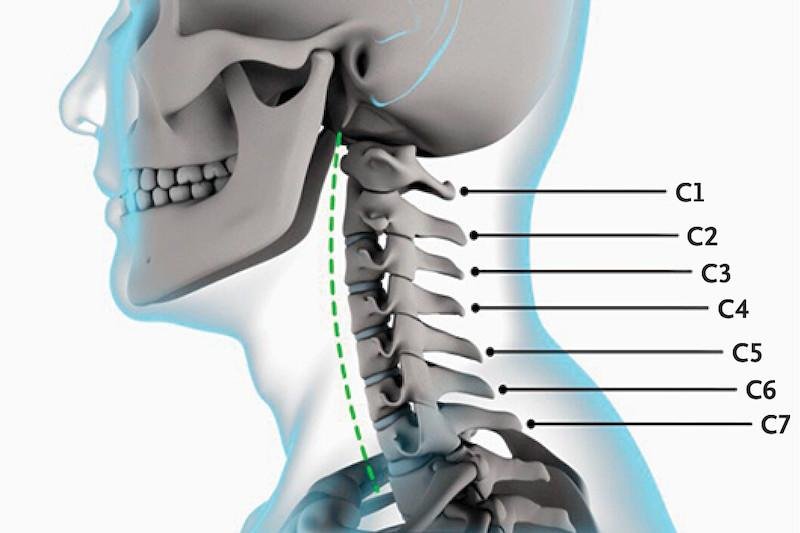
The cervical spine consists of seven vertebrae, labelled C1 to C7. Intervertebral discs sit between most of these vertebrae and act as cushions. They help absorb loads, maintain spacing and allow the neck to bend, rotate and move.
Each disc has two main components:
- Annulus fibrosus: The tough outer ring that surrounds the disc.
- Nucleus pulposus: The softer, gel like centre that helps distribute pressure.
With ageing, injury or degenerative changes, a disc may lose hydration, develop cracks or bulge outward. A herniated disc or bone spurs may narrow the space available for a nerve root or the spinal cord.
Common symptoms include:
- Neck pain or stiffness.
- Pain spreading into the shoulder, arm or hand.
- Tingling or numbness in the fingers.
- Weakness in the arm or hand.
- Reduced hand coordination or difficulty with fine movements.
- Balance or walking difficulties in some people with spinal cord compression.
Not every cervical disc abnormality seen on an MRI requires surgery. The scan findings must be interpreted alongside the patient’s symptoms and neurological examination.
What Is Cervical Disc Replacement?
Cervical Disc Replacement, also called Cervical Disc Arthroplasty (CDA), is a procedure in which the damaged cervical disc is removed and replaced with an artificial disc implant.
The procedure is generally performed through a small incision at the front of the neck. The surgeon removes the damaged disc and decompresses the affected nerve root or spinal cord. An artificial disc is then placed in the space between the vertebrae.
Unlike fusion surgery, the artificial disc is designed to preserve movement at the operated level.
Main goals of cervical disc replacement
- Remove the damaged disc.
- Relieve pressure on compressed nerves or the spinal cord.
- Maintain movement at the treated spinal level.
- Preserve the natural spacing between the vertebrae.
- Reduce the need to permanently fuse the treated segment.
Who may be suitable for cervical disc replacement?
Cervical disc replacement may be considered for carefully selected patients who have:
- Symptomatic cervical disc herniation or degenerative disc disease.
- Nerve root compression causing arm pain, numbness or weakness.
- Selected cases of spinal cord compression caused by disc disease.
- One or two suitable affected levels, depending on the implant’s approved indication.
- Persistent symptoms despite an appropriate course of non surgical treatment, or neurological deterioration that warrants surgery.
- Adequate bone quality and preserved movement at the affected segment.
- No significant instability or severe facet joint disease at the treatment level.
The exact eligibility criteria depend on the specific artificial disc device, its approved indications and the patient’s anatomy.
What Is ACDF Surgery?
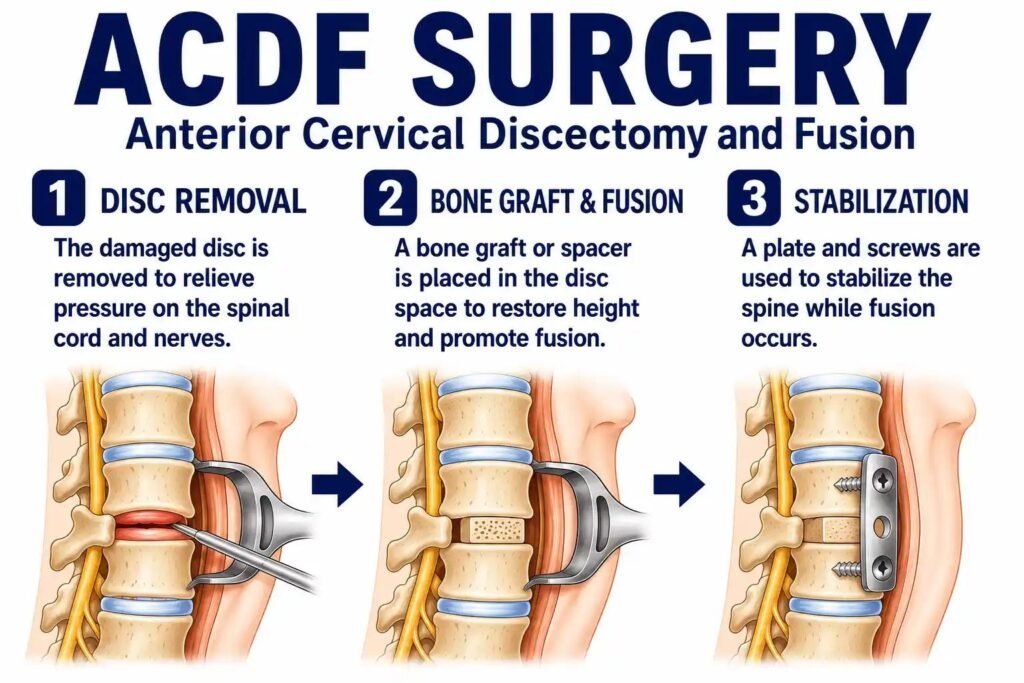
Anterior Cervical Discectomy and Fusion, commonly called ACDF, is an established operation used to treat selected cervical disc herniations, degenerative disc disease and nerve or spinal cord compression.
In this procedure, the surgeon reaches the cervical spine through an incision at the front of the neck. The damaged disc and any bone spurs or other tissue compressing the nerve or spinal cord are removed.
A bone graft or implant spacer is then placed between the vertebrae. A plate and screws may be used to provide additional stability while the bones heal and fuse together.
Main goals of ACDF
- Remove the damaged disc and compressive material.
- Relieve pressure on the nerve roots or spinal cord.
- Restore or maintain disc space height.
- Stabilise the affected spinal segment.
- Correct selected alignment problems when appropriate.
Who may be suitable for ACDF?
ACDF may be recommended for patients with:
- Persistent cervical radiculopathy due to disc herniation or bone spurs.
- Selected cases of cervical myelopathy caused by compression at the front of the spinal canal.
- Significant disc degeneration with loss of disc height.
- Spinal instability or deformity requiring stabilisation.
- Severe facet joint degeneration that makes disc replacement unsuitable.
- Certain patterns of multilevel disease or compression that require a fusion based reconstruction.
ACDF is not limited to patients who are unsuitable for artificial discs. It remains an effective surgical option when fusion is the more appropriate way to decompress and stabilise the cervical spine.
Cervical Disc Replacement vs ACDF: Key Differences
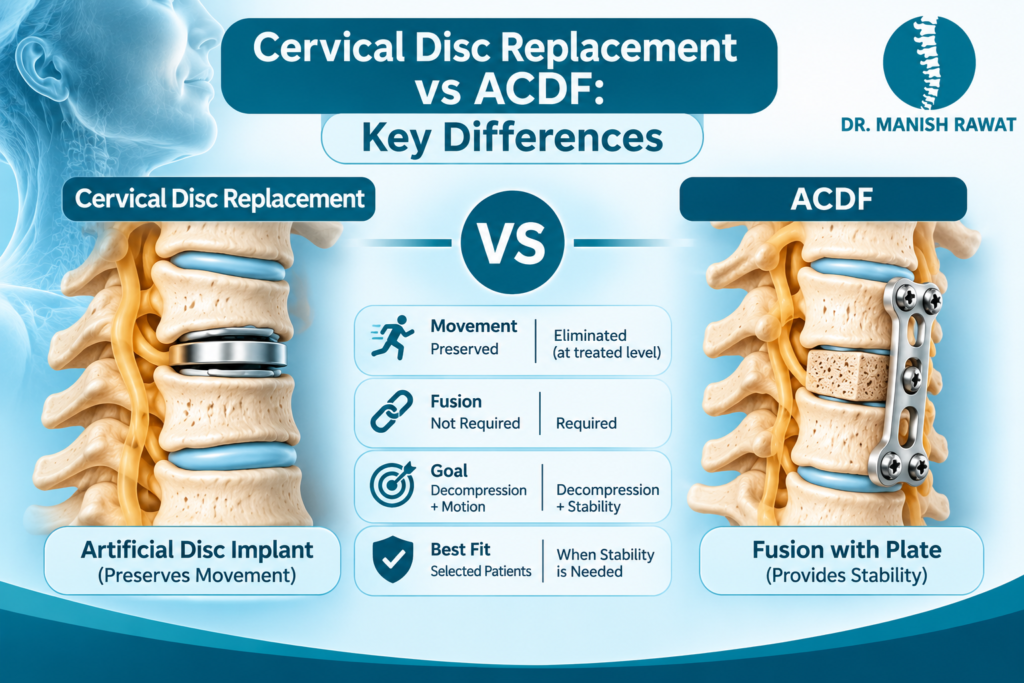
The most important difference is whether movement is preserved or eliminated at the treated level.
| Feature | Cervical Disc Replacement | ACDF |
|---|---|---|
| Damaged disc | Removed | Removed |
| Implant | Artificial mobile disc | Spacer or bone graft |
| Movement at treated level | Designed to preserve movement | Fusion eliminates movement at that level |
| Main objective | Decompression with motion preservation | Decompression with stabilisation |
| Bone fusion required | No | Yes |
| Suitable anatomy | Requires appropriate bone quality, stability and facet joints | Can be suitable when stabilisation is needed |
| Adjacent level movement | Preserved at operated level | Neighbouring levels compensate for lost movement |
| Long term considerations | Implant wear, movement and device related issues | Fusion healing, non union and adjacent segment problems |
Neither operation is automatically better for every patient. The right procedure is the one that safely addresses the cause of compression and provides appropriate stability.
1. Preservation of Neck Movement
One of the main differences between these procedures is movement at the operated spinal level.
Cervical disc replacement: The artificial disc is designed to allow controlled movement between the treated vertebrae. This can help preserve the overall movement of the neck, although the amount of movement varies with the implant and the patient’s anatomy.
ACDF: The two vertebrae are intended to join into one solid segment. Movement at that particular level is eliminated once fusion occurs. Other cervical levels continue to provide neck movement.
For patients who are suitable for either procedure, preserving motion may be an important consideration. However, motion preservation alone does not determine which surgery is safest or most effective.
2. Adjacent Segment Disease: Does Disc Replacement Reduce the Risk?
Adjacent segments are the spinal levels immediately above and below the operated level.
After ACDF, the fused segment no longer moves. This changes the movement and loading pattern across the neck. Over time, neighbouring discs may develop degenerative changes. This is commonly discussed as adjacent segment degeneration.
Cervical disc replacement is designed to preserve movement at the operated level, potentially reducing some of the biomechanical changes associated with fusion.
Research comparing the procedures has reported lower rates of certain secondary surgeries after cervical disc replacement in selected patients. However, disc replacement does not eliminate the possibility of adjacent level degeneration, and not every radiological change causes symptoms or requires another operation.
3. When Is Cervical Disc Replacement More Suitable?
Cervical disc replacement may be a reasonable option when the patient has a symptomatic disc problem but the affected spinal segment is still structurally suitable for motion preservation.
Factors that may support this option include:
- One or two appropriately selected cervical disc levels.
- Good bone quality.
- No significant instability.
- No severe facet joint arthritis.
- Preserved movement at the affected level.
- Nerve or spinal cord compression that can be adequately treated by removing the disc.
- Symptoms and imaging findings that correspond to one another.
The patient’s age alone should not decide the operation. Bone quality, spinal anatomy, the condition of the facet joints and the specific device’s approved criteria are also important.
4. When Is ACDF More Suitable?
ACDF may be preferred when the affected spinal segment needs stabilisation or when the anatomy is not appropriate for an artificial disc.
Examples include:
- Significant spinal instability.
- Severe facet joint degeneration.
- Advanced disc collapse with substantial loss of normal disc height.
- Severe spondylosis with bridging bone spurs and very limited movement.
- Selected cervical deformities.
- Certain cases of multilevel disease.
- Poor bone quality or other conditions that make artificial disc implantation unsuitable.
Some conditions, such as osteoporosis, infection, active malignancy at the operative site or specific inflammatory spinal diseases, may affect whether an artificial disc can be used. The decision must follow the implant’s approved instructions and an individual assessment. PubMed Central (PMC)+2
5. What Tests Are Needed Before Choosing the Surgery?
A careful assessment is necessary before recommending cervical disc replacement or ACDF.
Clinical and neurological examination
The doctor evaluates:
- Neck and arm pain.
- Numbness and tingling.
- Muscle strength in the arms and hands.
- Reflexes and sensation.
- Hand coordination.
- Walking and balance.
- Signs of spinal cord dysfunction.
MRI of the cervical spine
MRI helps identify:
- Disc herniation.
- Nerve root compression.
- Spinal cord compression.
- Spinal canal narrowing.
- Changes in the spinal cord, including signal abnormalities.
X-rays and dynamic imaging
X-rays help assess spinal alignment, disc space height and bony changes. Flexion and extension X-rays may be used when clinically appropriate to assess abnormal movement or instability.
CT scan
A CT scan may be useful for examining bone spurs, calcification, facet joint changes and other bony details.
Bone health assessment
Bone density testing or other investigations may be considered if there is concern about osteoporosis or poor bone quality, particularly when artificial disc replacement is being evaluated.
The final decision should match the symptoms, examination and imaging findings rather than relying on an MRI report alone.
6. Can Cervical Disc Problems Be Treated Without Surgery?
Yes. Many people with cervical disc related symptoms improve without an operation.
Depending on the diagnosis and severity, non surgical treatment may include:
- Appropriate pain relieving or anti inflammatory medication.
- Physiotherapy under professional guidance.
- Posture and ergonomic changes.
- Activity modification.
- A supervised exercise programme.
- Selected nerve root or epidural injections.
Treatment should be individualised. Exercises or neck manipulation that worsen symptoms should be avoided.
Important: Progressive arm or hand weakness, worsening balance, difficulty walking, loss of hand coordination or other signs of spinal cord compression require prompt medical assessment. Do not delay evaluation while trying home treatment.
7. How Are Cervical Disc Replacement and ACDF Performed?
Both procedures are commonly performed through an anterior approach, meaning the surgeon reaches the cervical spine from the front of the neck.
Steps in cervical disc replacement
- The patient receives general anaesthesia.
- A small incision is made at the front of the neck.
- The surgeon carefully reaches the affected cervical disc.
- The damaged disc and compressive material are removed.
- The nerve root or spinal cord is decompressed.
- The appropriate artificial disc is positioned between the vertebrae.
- Implant position and alignment are checked before closure.
Steps in ACDF
- The patient receives general anaesthesia.
- The surgeon makes an incision at the front of the neck.
- The affected disc is removed.
- Bone spurs or other compressive tissue are removed as needed.
- A bone graft or spacer is placed between the vertebrae.
- A plate and screws may be used for additional stability.
- The incision is closed, and the fusion process begins during recovery.
The exact surgical technique and implant choice depend on the patient’s anatomy, the number of levels treated and the surgeon’s assessment.
8. Benefits and Possible Risks of Both Procedures
Every spine operation has potential benefits and risks. The risks depend on the patient’s health, the condition being treated, the number of levels involved and the surgical technique.
| Cervical Disc Replacement | ACDF |
|---|---|
| Preserves movement at the treated level | Provides stability through fusion |
| Avoids the need for bone fusion at that level | Has an established role in cervical decompression |
| May reduce certain adjacent level reoperation risks in selected patients | Can address disease where motion preservation is unsuitable |
| Has implant specific risks, including wear, migration or bone formation around the implant | Has risks of non union, hardware problems and adjacent level degeneration |
Risks shared by both procedures
Possible complications include:
- Infection or bleeding.
- Anaesthesia related complications.
- Nerve or spinal cord injury.
- Persistent or recurrent symptoms.
- Difficulty swallowing (dysphagia).
- Hoarseness or voice changes.
- Blood vessel or nearby tissue injury.
- Need for further surgery.
Additional considerations with disc replacement
Artificial disc replacement may also involve:
- Implant displacement or loosening.
- Wear or mechanical failure.
- Bone formation around the implant that can limit movement.
- Persistent pain if the symptoms are caused by another spinal structure.
Additional considerations with ACDF
ACDF may also involve:
- Failure of the bones to fuse (non union or pseudarthrosis).
- Graft or implant related problems.
- Loss of movement at the fused segment.
- Possible need for further treatment if fusion does not occur.
A surgeon should discuss the risks that are most relevant to the individual patient before surgery.
9. Recovery After Cervical Disc Replacement vs ACDF
Recovery varies from person to person. It depends on the number of levels treated, the severity of nerve compression, overall health, the surgical approach and whether complications occur.

Recovery after cervical disc replacement
Some patients can begin walking soon after surgery, with activity increased gradually. Because the procedure does not depend on bone fusion, recovery does not involve waiting for the treated vertebrae to unite. However, the tissues still need time to heal, and activity restrictions may apply.
Recovery after ACDF
Patients also generally begin mobilisation early, as advised by the surgical team. The bones need time to fuse, and follow up appointments and imaging may be used to monitor healing. Some patients may be advised to wear a cervical collar for a period, depending on the operation and surgeon’s instructions.
General recovery guidance
- Follow the surgeon’s instructions about activity and lifting.
- Keep the incision clean and follow wound care advice.
- Avoid driving until medically cleared.
- Attend scheduled follow up appointments.
- Start physiotherapy only when advised.
- Report new weakness, worsening numbness, fever, wound problems or difficulty breathing or swallowing promptly.
There is no single recovery timeline that applies to everyone. Return to work and normal activities should be based on clinical progress and the surgeon’s advice.
10. How Does a Neurosurgeon Decide Which Surgery Is Right?
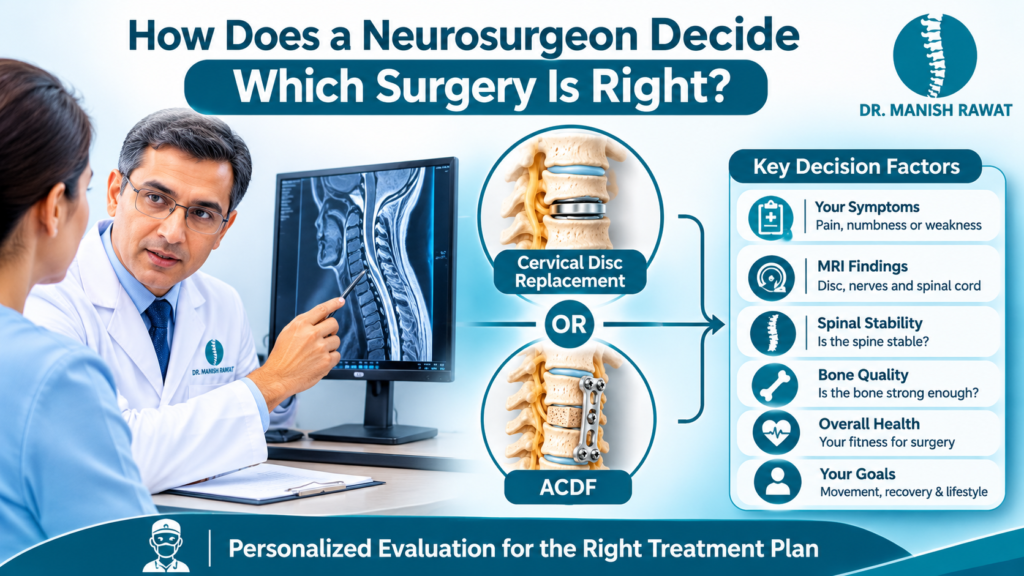
Choosing between cervical disc replacement and ACDF requires more than comparing the implants.
A neurosurgeon considers several factors:
- Symptoms: Whether the patient has neck pain, arm pain, numbness, weakness or signs of spinal cord dysfunction.
- MRI findings: Whether the disc or bone spurs are actually compressing the corresponding nerve or spinal cord.
- Spinal stability: Whether the affected level moves abnormally or needs additional stabilisation.
- Facet joint condition: Whether the small joints at the back of the neck are healthy enough for motion preservation.
- Bone quality: Whether the vertebrae can safely support an artificial disc.
- Number of affected levels: Whether one or more levels require treatment and which implants are approved for that situation.
- Overall health: Medical conditions, previous operations and other factors that may affect surgical safety and healing.
- Patient goals: Expected pain relief, function, activity requirements and informed preferences.
The best procedure is not necessarily the newest or most technologically advanced one. It is the procedure that safely treats the underlying problem and suits the patient’s spinal anatomy.
When Should You Consult a Neurosurgeon?
You should seek a medical evaluation if you experience:
- Persistent neck pain that spreads into the shoulder or arm.
- Numbness or tingling in the fingers.
- Weakness while holding objects or performing daily activities.
- Difficulty with buttons, handwriting or other fine hand movements.
- Problems with balance or walking.
- Symptoms that continue despite appropriate treatment.
Seek urgent medical assessment
New or rapidly worsening limb weakness, difficulty walking, loss of coordination, or new bladder or bowel control problems may indicate serious neurological compression. These symptoms should not be ignored.
Conclusion
Cervical disc replacement and ACDF are both established surgical options for treating selected cervical disc conditions. Both aim to remove the damaged disc and relieve pressure on the nerves or spinal cord.
The key difference is that cervical disc replacement is designed to preserve movement at the treated level, whereas ACDF stabilises the segment by joining the adjacent vertebrae.
Disc replacement may be suitable for patients with appropriate bone quality, stable spinal anatomy and healthy facet joints. ACDF may be a better option when the affected segment requires stabilisation or when advanced degeneration makes artificial disc replacement unsuitable.
There is no universally superior procedure. A detailed neurological examination, appropriate imaging and individual surgical assessment are essential to determine which approach is most suitable.
For patients experiencing persistent neck pain, arm pain, numbness or weakness, consultation with an experienced neurosurgeon can help identify the cause and discuss appropriate treatment options.
Frequently Asked Questions
1. Is cervical disc replacement a major surgery?
Yes. It is a specialised spine operation performed under general anaesthesia. Although the procedure uses an anterior neck approach, it requires careful decompression and precise placement of an artificial implant.
2. Can cervical disc replacement be performed at two levels?
Yes, certain artificial cervical disc devices are approved for use at two adjacent levels in appropriately selected patients. Eligibility depends on the specific implant and the patient’s clinical condition.
3. Does ACDF permanently restrict neck movement?
ACDF permanently eliminates movement at the fused level once fusion is successful. However, the remaining cervical levels continue to provide movement.
4. Can a patient need another surgery after cervical disc replacement?
Yes. Although disc replacement may reduce certain secondary surgery risks in selected populations, further surgery may still be necessary because of implant related problems, persistent compression or degeneration at another level.
5. Is cervical disc replacement suitable for older patients?
Age alone does not determine suitability. Bone density, facet joint health, spinal stability, disc degeneration and the implant’s approved criteria are important considerations.

Doctor Manish Rawat, the best neurosurgeon in Gurugram, is a highly accomplished Senior Neurosurgeon with over 25 years of medical experience, including 18 years dedicated to neurosurgery.